
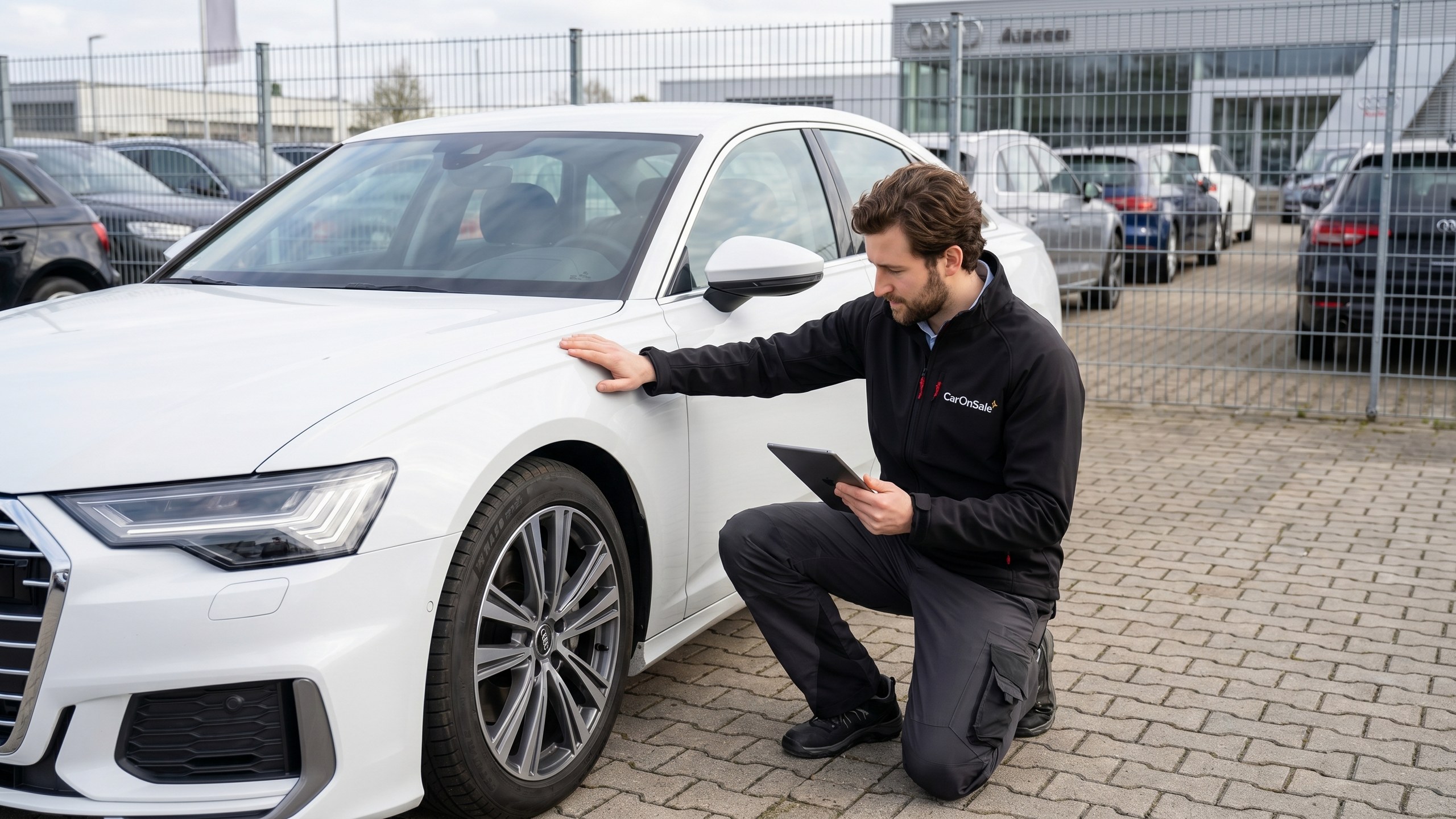
The Basics of Vehicle Appraisal in the B2B Sector

Vehicle appraisal in the B2B sector is the systematic determination of the market, time, or residual value of a used car through standardized inspection procedures. It provides dealers, fleet operators, and leasing companies with a reliable basis for purchasing, selling, and remarketing. In a European used-car market that reached a value of $725.3 billion in 2024 and is projected to grow at an annual rate of 4.6% through 2034 (Global Market Insights), the quality of the appraisal determines the margin and speed of each individual transaction.
In the CarOnSale workflow alone, approximately 1.2 million vehicles go through standardized valuation and marketing processes each year. This illustrates the volume of business that professional B2B players handle digitally today. This article explains the key valuation methods, sourcing channels, and transaction steps that define the professional B2B used-car trade.
What is a vehicle appraisal in a B2B context?
In the commercial used-car trade, vehicle valuation isn’t about the individual buying experience, but rather about safeguarding entire flows of inventory. Whether you handle dozens or hundreds of vehicles a month, every incorrect valuation directly impacts the profit per vehicle. That’s why the B2B sector requires different tools and standards than the private market.
Market Value, Fair Value, and Residual Value: The Three Key Metrics
In day-to-day business, three concepts related to value are often used interchangeably, even though they describe different things:
Market value: the price that could typically be obtained if the vehicle were sold at the time of the appraisal. It is based on supply and demand in the regional or national automotive market.
Market value: takes into account the financial depreciation resulting from age, use, and wear and tear. It describes the condition of an asset over its typical useful life and is frequently used in insurance-related appraisals.
Residual value: relevant for accident-damaged vehicles and residual value exchanges. It describes the amount that a damaged or economically written-off vehicle can still fetch.
In the B2B automotive trade, it is also crucial to distinguish between the dealer purchase price (HEK) and the dealer selling price (HVK). The markup between these two values determines the contribution margin per vehicle.
Why B2B Reviews Differ from Those in the Consumer Market
A private buyer appraises a single vehicle and has days or weeks to do so. In B2B business, different rules apply. The process is driven by volume: Anyone appraising hundreds of vehicles per month needs reproducible standards rather than individual, gut-feel assessments. The focus is on margins. Every vehicle that sits on the lot too long costs money. The appraisal must therefore not only accurately reflect the vehicle’s condition but also factor in how quickly it can be sold.
The average purchase price for used cars was 18,310 euros in 2025, and prices have remained at a high plateau since 2022 (DAT, DAT Report 2026). In such an environment, any error in valuation becomes a direct margin problem.
Who conducts the evaluations: internal teams, experts, and digital tools
In the B2B context, valuation is a shared responsibility. In-house GW managers have market knowledge and experience, but do not always work according to uniform standards. External experts (TÜV, DEKRA, GTÜ) provide legally sound appraisals, but are too slow and expensive for every transaction in high-volume business. Digital valuation tools and platform algorithms complement both approaches by processing market data in real time and providing indicative values within seconds.
Experience shows that companies achieve the best results when they combine all three approaches: an algorithm for the initial valuation, experienced appraisers for fine-tuning, and external expert opinions for disputed cases or high-value vehicles.
What is involved in a professional on-site vehicle appraisal?
An on-site assessment is essential when online data reaches its limits. Factors that increase or decrease value can only be identified through a physical inspection. In B2B business, however, this inspection must be conducted quickly, consistently, and in a documented manner.
External and Technical Condition Inspection
The physical inspection begins with the body. Paint thickness measurements reveal repainting, which indicates repaired accident damage. The condition of the tires, brakes, suspension, and underbody is systematically assessed. Modern assessment standards use checklists that cover numerous inspection points. In the COSCheck process, for example, over 110 inspection points and at least 25 photos per vehicle are documented. This level of detail provides the transparency that professional buyers need to make a decision on a remote purchase.
In addition, OBD2 diagnostics are used. The diagnostic interface allows stored error codes to be read, which indicate problems with the engine control system, exhaust system, or driver assistance systems. The odometer reading is checked for plausibility to detect tampering.
Document Comparison and History Review
The document review is conducted in parallel with the technical inspection. The vehicle registration certificate (Parts I and II), service log, HU and AU certificates, maintenance invoices, and any accident reports are cross-checked. A complete service log is not a bonus, but a prerequisite for a solid appraisal. Missing documentation creates uncertainty and drives down the price.
In B2B business, there is another aspect to consider: verifying the vehicle identification number (VIN). VIN lookups allow you to retrieve equipment codes, digital service records, and, in some cases, accident reports. This significantly reduces the risk of making the wrong purchase at online auctions.
Assessment Report and Condition Report
The result of a professional evaluation is a standardized condition report. This report serves as a basis of trust between the buyer and Seller. In B2B trade, where vehicles are often purchased without a test drive, the quality of this report is critical to business.
Good condition reports follow recognized inspection guidelines (e.g., TÜV or DEKRA standards) and document every defect found with a photo and a written description. They distinguish between normal wear and tear and damage that affects the vehicle’s value. For the buyer, this reduces the number of complaints; for the Seller , it builds trust and speeds up sales.
What factors influence the value of a used car?
Determining the value of a used car is not a simple formula. It results from the interplay of technical characteristics, market forces, and soft factors, which are weighted differently depending on the vehicle type and target market.
Vehicle Age, Mileage, and Features
Age and mileage form the basis of every appraisal. A newer vehicle with high mileage is appraised differently than an older one with lower mileage. Features play a role especially when they influence demand: navigation systems, LED headlights, or driver-assistance packages have a positive effect, while rarely requested optional features have less of an impact.
With over six million transfers of ownership annually, the used-car market is significantly larger than the private new-car market, which sees approximately 960,000 new registrations to private individuals (DAT, DAT Barometer). Given this volume, demand for specific equipment combinations has a greater impact on price than the list price at the time of initial registration.
Market Conditions, Seasonality, and Demand Trends
External factors have a significant impact on a vehicle’s value. Convertibles fetch higher prices in the spring than in November. SUVs dominate demand: In 2025, SUVs accounted for over 50 percent of leasing inquiries in Germany (LeasingMarkt.de, Leasing-Rückspiegel 2025). By factoring these demand trends into the valuation, you can sell vehicles at the right time and at the best price.
The electric vehicle segment is particularly volatile at the moment. In March 2025, three-year-old electric cars were still worth 51.5% of their original new-car price, while three-year-old Petrol were worth 64% and diesel vehicles 62.7% (ALD Automotive / LeasePlan). The gap between internal combustion engine vehicles and electric vehicles continues to widen.
Condition, Maintenance History, and Number of Previous Owners
In B2B sales, soft factors often tip the scales. A vehicle with a documented previous owner and a complete service history fetches measurably higher prices than a comparable model with an unclear history. Equally relevant is the vehicle’s repair history. Unrepaired previous damage, missed maintenance, or visible wear and tear in the interior significantly reduce the vehicle’s value.
Professional used-car dealers systematically factor these elements into their calculations. They distinguish between defects that must be repaired before resale and those that the end customer is willing to accept. This calculation determines the purchase price and, consequently, the subsequent profit margin.
What is a lease return, and what do dealers look for in terms of quality?
Lease returns are one of the most important sources of supply in the B2B used-car trade. They offer predictable quality and volume, but require a careful assessment of their condition.
Definition and Typical Profile of a Leased Vehicle Returned at the End of the Lease
A lease return is a vehicle that has been returned to the lessor upon the expiration of a lease agreement. Typically, these vehicles are only a few years old and have moderate mileage. Since lease agreements require regular maintenance, lease returns generally have a complete service record and a documented vehicle history.
The segment of young used cars gained importance in the German leasing market in 2025: Its share of the total market rose by 2.4 percentage points to 16.5 percent (Dataforce, 2025 Leasing Study). For B2B buyers, this means more available inventory in an attractive age and price segment.
Quality Inspection and Damage Classification
Not every leased vehicle returned at the end of a lease is automatically a good deal. The quality inspection must systematically distinguish between normal wear and tear and damage that affects the vehicle’s value. Scratches on bumpers, minor stone chips, or signs of wear on the steering wheel are considered normal wear and tear. Dents in the body, damaged rims, or tears in the interior are types of damage that reduce the vehicle’s value.
Professional appraisal systems use damage catalogs that classify each defect into a category and assign an estimated range of repair costs. This allows the buyer to quickly calculate the total initial cost—the purchase price plus reconditioning costs—which is then offset against the expected sales proceeds.
Opportunities and Risks for B2B Buyers
Leased return vehicles are considered an attractive source of supply because a new car experiences its greatest loss in value during the first three years. Buyers purchase the vehicle after this initial drop in value and benefit from a lower entry price combined with comparatively high quality.
Mercedes-Benz, for example, markets its lease returns in Europe exclusively through a dedicated B2B platform. Such OEM-controlled channels offer predictability and quality standards that cannot be taken for granted in the open market. The risk lies in the limited scope for price negotiation: Those who purchase through standardized channels accept the pricing logic that prevails there.
64 percent of used-car buyers and prospective buyers in Germany are reluctant to purchase a used all-electric vehicle (DEKRA / Ipsos, Used Car Sales Study 2025). Anyone purchasing returned electric lease vehicles must factor this gap in demand into their calculations.
What does vehicle procurement through authorized dealers and OEMs mean?
In addition to lease returns, OEMs and authorized dealers supply additional vehicles to the B2B market. These procurement channels offer specific advantages, but also have limitations.
OEM Direct Sales and Dealer Agreements
Original equipment manufacturers channel vehicles into the B2B market through various channels: demonstration vehicles, company cars, employee vehicles, and vehicles with short-term registrations. These vehicles typically have low mileage, a known history, and are often well-equipped.
Access to these channels varies for car marketplaces, dealers, and individual businesses. Large dealer groups with contractual agreements receive preferential access. Independent dealers access these vehicles through B2B platforms or car auctions.
Fleet liquidations and factory vehicles as a procurement channel
Fleet liquidations provide volume in a predictable quality. Companies that replace their vehicle fleets often dispose of dozens to hundreds of similar vehicles. For B2B buyers, this means uniform models, comparable conditions, and thus efficient evaluation and marketing.
Currently, only 6 percent of fleets lease at least one used vehicle. At the same time, up to 22 percent of fleet managers express a general interest in leasing a used vehicle (Dataforce, 2025 Leasing Study). This untapped potential indicates that the cycle between fleet returns and used vehicle leasing will intensify in the coming years.
Advantages and Disadvantages Compared to Independent Sourcing Channels
OEM channels offer transparency, often a remaining warranty, and standardized condition reports. The disadvantages include limited pricing flexibility and dependence on the manufacturer’s terms and conditions. Alternative sourcing channels, such as B2B online auctions or direct purchases from other dealers, offer greater flexibility in pricing but require independent quality assurance.
In practice, most high-volume dealerships combine both approaches. OEM channels provide the predictable base volume, while independent sources supplement this with high-margin one-off vehicles and export vehicles.
What does vehicle remarketing mean in the B2B used-car trade?
Remarketing encompasses all activities a vehicle undergoes from the end of its current life cycle (end of lease, fleet decommissioning, trade-in) until it is resold to the next user. In a B2B context, remarketing is not a minor matter, but rather a significant contributor to results.
The Remarketing Process: From Appraisal to Marketing
The process chain in professional remarketing follows a clear sequence:
Allocation Decision: Will the vehicle remain in the retail business or be sold through the B2B channel?
Inspection and Condition Report: Standardized assessment based on defined criteria.
Pricing: Algorithm-based or by experienced appraisers—ideally both.
Channel selection: auction, direct sale, or hybrid model.
Refurbishment: Technical repairs and cosmetic improvements, to the extent that it makes economic sense.
Marketing and Sales: Through the selected platform or channel.
Logistics and Handover: Transportation, document transfer, deregistration.
Every step is a potential bottleneck. That’s why professional companies measure the lead time for each phase and continuously optimize their processes.
Auction platforms, direct sales, and hybrid models
The choice of sales channel depends on the type of vehicle, the expected proceeds, and the desired speed of the sale. Auctions for dealers generate competition among bidders and drive up the price, but they require accepting a certain degree of price risk. Direct sales offer predictability, but are often slower and less scalable.
Hybrid models combine both approaches: Vehicles that do not sell at auction are offered for direct sale. Alternatively, they are listed with a guaranteed minimum price, which provides security for the “ Seller ,” while the auction mechanism determines the best possible price. At CarOnSale, the overall transaction rate in 2025 is 76 percent, demonstrating the effectiveness of standardized valuation and marketing processes in B2B commerce.
Reduce days in inventory and increase contribution margins
Dwell time is the silent margin killer in the used-car trade. Every day a vehicle sits on the lot instead of being sold costs money: tied-up capital, parking space costs, and depreciation. Experience from high-volume businesses shows that consistent B2B marketing through an exclusive platform partner generates higher contribution margins per unit than decentralized, individual solutions.
The key lies in the speed of the entire process: rapid evaluation, rapid pricing, rapid transportation, and rapid marketing. Anyone who can reduce this process—from the initial report to the award of the contract—to less than ten days protects their margin.
What documents and steps are involved in a B2B used-car purchase?
A commercial vehicle purchase requires more documentation than a private sale. Complete and accurate processing is essential for legally sound transactions and seamless logistics.
Required documents: Vehicle title, vehicle registration certificate, bill of sale
Every B2B used-car purchase must include at least the following:
Certificate of Registration, Part II (Vehicle Title): serves as proof of ownership and is required for re-registration
Certificate of Registration, Part I (Vehicle Registration Certificate): contains the vehicle's technical specifications
Sales contract with a complete description of the vehicle, all known defects, and the agreed-upon purchase price
Most Recent Vehicle Inspection (HU) and Medical Examination (AU) Certificates
Service log and available maintenance invoices
All existing vehicle keys and code cards
In a B2B context, additional documents are often required: powers of attorney (if the Seller is not the registered owner), reports on prior damage, and, in the case of fleet vehicles, often a certificate of origin from the lessor.
Commercial Considerations: Invoicing, Warranty, Export Documents
Different rules apply to commercial transactions than to private purchases. The warranty between businesses can be contractually excluded, which is common practice in B2B transactions. Instead of a receipt, a proper invoice showing the sales tax is issued, provided that differential taxation does not apply.
For cross-border transactions, export documents, CMR waybills, and, if applicable, customs documents are also required. Professional buyers from more than 20 European countries conduct business via B2B platforms, which increases documentation requirements. Sixty percent of used-car shoppers prefer digital channels when contacting a dealer (DEKRA / Ipsos, Used Car Sales Study 2025). This trend toward digitalization is also shaping document transmission in B2B business.
Delivery, Logistics, and Digital Processing
Modern B2B platforms significantly speed up the process. Instead of manual document verification, phone calls, and separate logistics bookings, the purchase, document transfer, and transport are all handled through a single system. Scanned documents are available digitally, and deliveries can be tracked in real time.
The handover itself follows a standard procedure: the vehicle’s condition at the time of pickup is documented, all keys and documents are transferred to the new owner, and the deregistration is either handled by Seller or governed by the terms of the contract. When selling used cars through digital channels, the administrative burden per vehicle is significantly reduced.
Digitalization and Future Trends in B2B Vehicle Appraisal
Vehicle valuation in the B2B sector is changing rapidly. Technologies that were still experimental just five years ago are now part of the standard toolkit for professionals in the field.
AI-powered evaluation and automated condition assessment
AI-driven systems are increasingly taking on tasks that were previously reserved for human assessors. Automatic damage detection via image analysis identifies scratches, dents, and paint damage based on photos. This significantly speeds up the initial assessment and provides an objective starting point, which the experienced assessor then refines.
The advantage: AI operates consistently. While human evaluators may produce varying results depending on their daily performance and experience, a trained algorithm generates reproducible assessments. The best systems combine AI-based detection with human validation to keep the error rate low. Nearly half of fleet managers have expressed interest in completing processes entirely digitally in the future (LeasingMarkt.de, Leasing-Rückspiegel 2025). This is also driving demand for automated evaluation procedures.
Real-Time Data-Driven Pricing
Databases such as the Schwacke List or the DAT Vehicle Valuation provide market-based reference values. However, they are no substitute for an individual appraisal, as they do not take into account the actual condition of the specific vehicle. Modern platforms combine this reference data with their own transaction data and demand signals from ongoing auctions.
At CarOnSale, an algorithm determines real-time market prices within seconds; COS experts then set a guaranteed minimum price within 15 to 20 minutes. This combination of speed and human oversight addresses a key need in high-volume business: fast yet reliable pricing. These prices are then validated in the market via automotive marketplaces and auction platforms.
Sustainability and Electric Vehicles as a New Dimension of Evaluation
Electric vehicles present new challenges for vehicle appraisals. In addition to traditional appraisal criteria, the battery’s condition has emerged as a key factor affecting value. State-of-Health (SoH) measurements of the battery are increasingly becoming a mandatory part of every electric vehicle appraisal.
Residual value trends for electric vehicles remain volatile. Used electric cars lose value at a higher rate than used internal-combustion vehicles. New cars accounted for the largest share of leasing inquiries in 2025, at 72 percent. This means that in the coming years, more electric vehicles returned from leases will enter the B2B market, and valuing them will require specialized expertise.
For B2B players, this means that those who invest in electric vehicle assessment capabilities today will gain a competitive edge when demand increases. Electric vehicles used by government agencies and in fleets will accelerate this trend.
Frequently Asked Questions About Vehicle Appraisals in the B2B Sector
How long does a professional vehicle appraisal take?
A standardized on-site assessment, including photographic documentation and a condition report, typically takes 30 to 60 minutes per vehicle. Digital preliminary reviews of vehicle data and photos at Basis provide an initial assessment within minutes. A complete vehicle appraisal report prepared by an expert typically takes one to two business days to complete.
What are the costs associated with a vehicle appraisal in the B2B sector?
The cost of individual appraisals by independent experts varies depending on the scope of the work. In high-volume business, B2B platforms use flat-rate fee models: On the CarOnSale platform, for example, a seller’s fee of 119 euros is charged for each vehicle successfully sold, with no subscription or upfront costs. Appraisal, photo documentation, and a condition report are all included in this process.
Can an online assessment replace an in-person exam?
A data-driven online appraisal is sufficient for an initial price estimate. However, it is no substitute for a physical inspection: paint damage, accident damage, interior wear and tear, and mechanical defects can only be reliably assessed in person. In B2B trading, a hybrid model has become the norm, in which algorithmic initial appraisals are supplemented by standardized on-site inspections.
What role do the DAT or Schwacke lists play in B2B valuation?
DAT and Schwacke provide market-based reference values at Basis , which consist of statistical comparison data. These values serve as a guide but do not reflect the specific condition of an individual vehicle. Professionals use these databases as a starting point and adjust the price based on the specific inspection results, the vehicle’s features, and current market demand.
Who is liable for an incorrect appraisal in commercial transactions?
Liability depends on the terms of the contract. If a condition report is agreed upon as the basis for the purchase agreement, the preparer is liable for its accuracy. Claims for damages may arise in the event of grossly inaccurate assessments. Platforms that use standardized condition reports often offer defined complaint procedures that resolve disputes more quickly than individual negotiations.
How does the valuation of electric vehicles differ from that of traditional internal combustion engine vehicles?
For electric vehicles, battery assessment is an additional key factor. The battery’s state of health significantly affects the vehicle’s value, as replacing the battery can cost tens of thousands. Furthermore, there is still a lack of sufficient comparative data for many electric models on the used-car market, which makes pricing difficult.
What are the benefits of standardized condition reports in B2B commerce?
Standardized reports promote comparability and build trust. Buyers can evaluate vehicles based on uniform criteria without having to inspect each one in person. This speeds up the purchasing decision, reduces the complaint rate, and facilitates cross-border trade, where an in-person inspection is often impractical.
How does the time a used car has been on the market affect its resale value?
Every additional day a vehicle remains in inventory incurs costs: tied-up capital, parking space rent, insurance, and ongoing depreciation all add up. Professional dealerships measure average inventory days as a key KPI and establish clear escalation levels. Vehicles that have not been sold to end customers after a defined period are consistently sold through the B2B channel to limit inventory days and secure revenue.
Conclusion: Vehicle Appraisal as the Foundation for Profitable B2B Trade
Vehicle appraisal is not an isolated step. It is the foundation upon which every profitable B2B transaction is built. Standardized inspection procedures with sufficient depth (110+ inspection points as a benchmark), reproducible condition reports, and data-driven pricing together form the backbone of an efficient appraisal process.
Knowing and combining the right procurement channels—whether lease returns, direct sales from OEMs, or judicial auctions—ensures a steady supply of goods. Efficient remarketing with consistent management of service life protects profit margins.
Three factors determine success: The quality of the appraisal determines the purchase price. The speed of marketing determines the time the vehicle spends on the lot. Process transparency determines the level of trust between the buyer and Seller. Those who master all three factors build a sustainable competitive advantage in the B2B used-car trade.


