
Fast Inventory Turnover: Techniques for Greater Success

Inventory turnover (also known as turnover rate) describes how often a car dealer sells its entire vehicle inventory within a defined period and replaces it with new inventory. A high turnover rate reduces downtime, minimizes tied-up capital, and increases the return on every euro invested. Every vehicle that sits on the lot for too long costs money: financing interest, depreciation, parking space costs, and tied-up capital that is unavailable elsewhere.
This article shows you exactly which strategies you can use to turn over your inventory faster. From data-driven purchasing strategies to dynamic pricing and shelf-life analysis, all the way to liquidation platforms and financing models: Here you’ll find the complete toolkit for improving inventory turnover.
What is inventory turnover, and why is it crucial for car dealers?
Definition and Calculation of the Turnover Rate
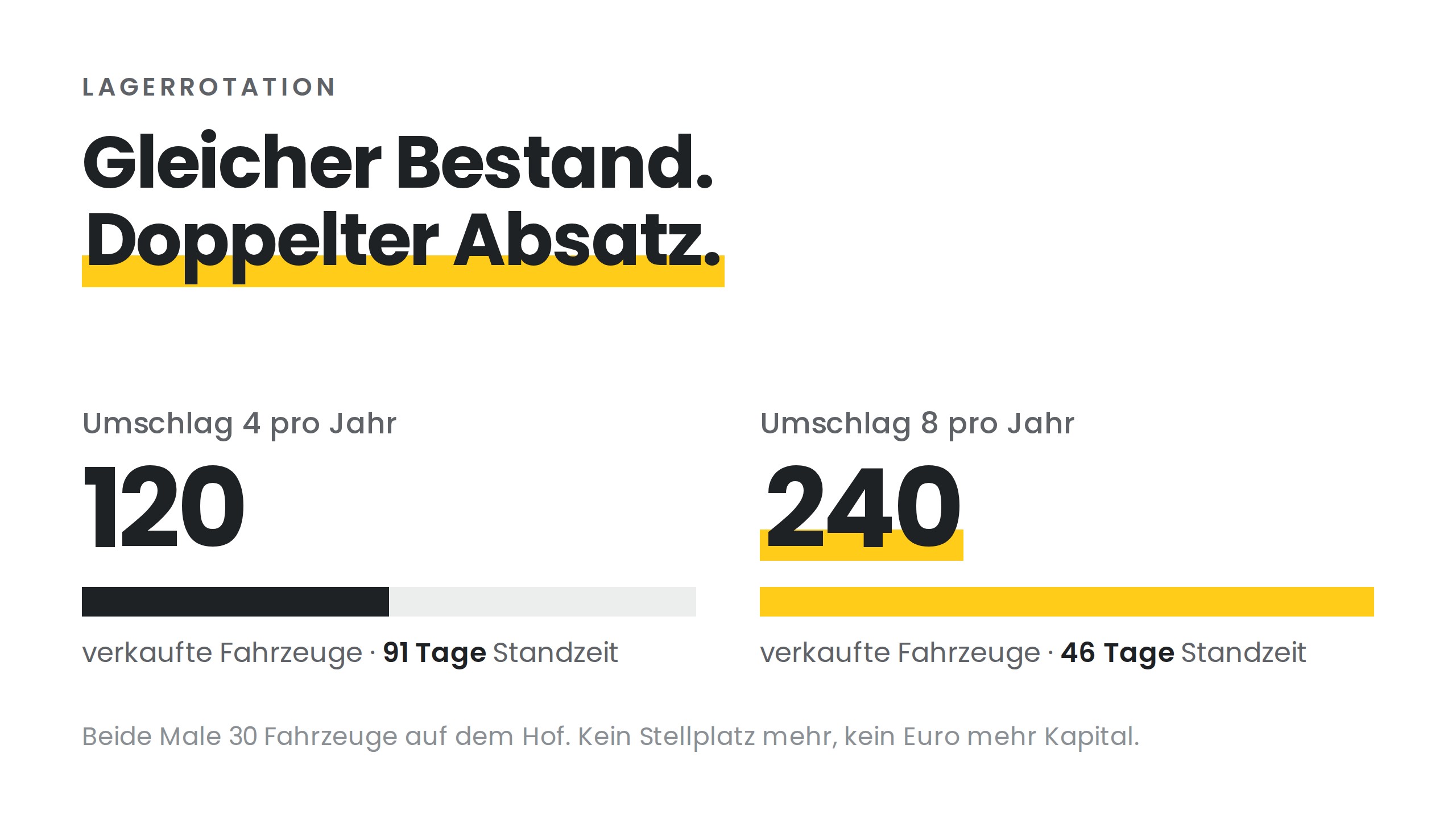
The inventory turnover rate indicates how often the average vehicle inventory is completely sold and replaced over a specific period. The formula is simple: sales volume divided by the average inventory. For example, if you sell 120 vehicles a year and keep an average of 30 vehicles in stock, the inventory turnover rate is 4. The resulting calculated dwell time is 365 divided by 4, or about 91 days per vehicle.
The gold standard is an inventory turnover rate of 12, which means that the entire inventory is completely turned over every 30 days (ACV Max). For used cars, a target range of 8 to 12 rotations per year is considered healthy (Carketa). In the German market, however, many dealerships fall well below this range.
Why Downtime Directly Eats Into Profits
Downtime is the silent profit killer in the used-car business. According to the DAT Barometer, average holding costs amount to 25 euros per day per vehicle, including financing costs, marketing, and storage and cleaning costs (DAT). With a fleet of 50 vehicles and an average holding time of 90 days, this adds up to over 112,000 euros per year—all resulting solely from waiting.
Added to this is depreciation: Used cars continuously lose value due to age, mileage, and market fluctuations. Vehicle segments with a Market Days Supply of more than 80 days are a clear warning sign, as the median price is likely to continue falling over the next 60 days (Carindex). What you don’t sell today will yield less profit tomorrow.
Industry Benchmarks: What Turnover Rates Are Realistic?
The average time on the market for all vehicles listed on mobile.de was most recently around 97.3 days (mobile.de / autohaus.de). This corresponds to a turnover rate of just under 4. Luxury vehicles remain on the market significantly longer, at an average of 137 days (EurotaxSchwacke via Statista), while compact cars, as fast-moving items, achieve the best average at around 96 days (Schwacke via flotte.de).
Internationally, manufacturers such as Toyota have shown that a inventory holding period of 44 to 45 days is possible, while Stellantis brands had periods exceeding 130 days (Cox Automotive). This range makes it clear that the difference between good and poor inventory turnover lies not in the market, but in the process.
How do dealers increase the turnover rate of their used car inventory?
Data-Driven Purchasing Instead of Gut Feelings
Purchasing is the most effective way to achieve rapid turnover. Buying vehicles without market data is a matter of chance. Data-driven purchasing means that before making any purchase decision, you check the level of demand for that specific model, trim level, and mileage in your region. Vehicle marketplaces for dealers provide real-time price benchmarks and supply volumes.
Specifically, this means: Keep an eye on which vehicles sell quickly in your market area. Prioritize purchasing these models. In many regions, a VW Golf with moderate mileage sells much faster. A luxury SUV with high mileage, on the other hand, can sit on the lot for much longer. The data is available—you just have to use it.
Dynamic Pricing and Automated Price Adjustments
Fixed prices are the enemy of fast turnover. If a vehicle hasn't sold after 30 days, either the price is wrong or the presentation isn't right. Dynamic pricing works through rule-based price reduction strategies: After 14 days without an inquiry, lower the price by 2%; after 30 days, lower it by another 3%; and after 45 days, lower it by 5%.
Pricing tools automate this process. They compare your listed price with the current market price daily and suggest adjustments. The advantage: You can react immediately to market changes instead of making manual corrections weeks later. Controlling your price means controlling your margin.
Professional Vehicle Detailing and Online Presentation
A vehicle that isn't listed can't be sold. Yet in many dealerships, days or weeks pass between purchase and online listing because vehicle preparation, photography, and ad creation aren't standardized. Shorten this process to a maximum of 48 hours.
High-quality photos (at least 20 per vehicle), complete condition descriptions, and professional listings are not a luxury—they’re a must. Buyers decide within seconds whether to click on a listing. Standardized condition reports, such as those commonly used in online auctions, build additional trust and speed up the purchasing decision.
What role does service life analysis play in inventory management?
KPIs and Early Warning Systems for Long-Term Patients
No measurement, no control. The most important KPIs for your inventory management are: average days in stock and storage costs, turnover rate by vehicle segment, percentage of vehicles in stock for more than 60 and more than 90 days, and revenue per day in stock.
Define clear thresholds: Any vehicle that has been in the lot for more than 60 days receives a price adjustment. Any vehicle that has been in the lot for more than 90 days is released for liquidation. These rules must be triggered automatically and should not depend on individual Seller . A weekly inventory report using a traffic-light system (green for under 30 days, yellow for 30 to 60 days, red for over 60 days) immediately highlights long-term vehicles.
Segmentation of the inventory by rotational speed
Not every vehicle turns over at the same rate, nor is that necessary. The key is to segment the fleet into three categories:
Fast-moving items (under 30 days): High-volume models with strong demand. Here, you maximize throughput and accept moderate margins per unit.
Standard-cycle products (30 to 60 days): A solid business with a balanced margin. Monitoring prices every two weeks is sufficient.
Problem vehicles (over 60 days): Immediate action required. Price reduction, change of sales channel, or liquidation.
In the German used-car market, the average time on lot for diesel vehicles was approximately 92 days (DAT). For electric vehicles, the figures fluctuated dramatically: from fewer than 30 days of Market Days Supply in 2022 to over 130 days in some markets in 2024 (Carindex). Such shifts require continuous segmentation of your inventory.
How much does inventory and floor plan financing cost for car dealers?
How Floorplan Financing Works
Floorplan financing (also known as dealer inventory financing, or HEF for short) is a revolving line of credit that dealers use to pre-finance vehicle purchases. Here’s how it works: The bank pays for the vehicle at the time of purchase. You repay the amount as soon as you sell the vehicle. In the meantime, you pay interest on the outstanding balance.
Interest rates are typically based on the three-month Euribor plus a credit-based markup. This means that the longer a vehicle sits idle, the more interest you pay. With some providers, principal repayment doesn’t begin until much later. That may sound convenient, but it masks the ongoing interest costs.
Cost Comparison: Interest Rates, Fees, and Hidden Costs
The typical cost categories for floorplan financing include:
Interest Rates: Variable, based on Euribor and creditworthiness.
Credit line fees: Some providers charge an annual commitment fee on the total credit line.
Processing fees: Per vehicle registration or as a flat fee.
Repayment Stages: Once the interest-free or payment-free period ends, costs rise sharply.
For a vehicle that has been sitting on the lot for a long time, financing costs and daily holding costs can quickly add up to a significant amount. The 25 euros in daily holding costs alone (space, marketing, detailing) significantly reduce the profit margin on a typical used car.
Overview of Providers
The leading floor plan providers in the German market are:
BDK (German Automotive Trade Bank): Provides financing for new and used cars, dealer initial registrations, and demonstration vehicles. Terms are based on creditworthiness and are uniform across all makes.
Creditplus Bank: Offers HEF at Basis based on the three-month Euribor plus a credit-based surcharge. Personal representatives instead of a call center. Financing is also available for registered vehicles.
BNP Paribas (Commerz Finanz): Primarily active in the manufacturer-independent sector.
Volkswagen Financial Services: Primarily for VW Group brands, but also available for other brands.
The choice of provider depends on the size of your business, your mix of vehicle makes, and your creditworthiness. The key factors are not only the interest rate, but also flexibility in repayment and the digital processing workflow.
Which platforms help sell vehicles more quickly?
B2B Auction Platforms as a Sales Channel
If a vehicle isn't selling in the retail market, it needs a fast B2B channel. Resale marketplaces and auction platforms offer exactly that: reach, speed, and a market-driven price in a short amount of time.
The established platforms in the German B2B automotive market are AUTO1.com, BCA, AURENA, and CarOnSale. They differ in terms of reach, auction format, and fee structure. AUTO1, for example, offers auctions to a large network of dealers, while BCA and AURENA connect fleet operators and leasing companies with dealers. CarOnSale has around 40,000 active professional buyers; over 85% of the inventory listed there is exclusive; and the seller’s fee is 119 euros per successfully sold vehicle, with no subscription or upfront costs. When choosing a platform, in addition to reach, the fee structure and the question of whether fixed costs or transaction-based fees align with one’s own inventory turnover strategy are decisive factors.
For export vehicles, the Europe-wide reach is particularly valuable: A vehicle that is a slow-moving item in Germany can be a fast-moving item in another European market.
Remarketing Channels and Multichannel Sales
Fast turnover requires more than one sales channel. Successful retailers combine:
Online marketplaces (mobile.de, AutoScout24) for retail sales
B2B auction platforms for vehicles with high days on lot
Social media channels (Facebook Marketplace, Instagram) for local reach
In-store sales with demonstrations and test drives
The used car market dominates the German auto market, with twice as many monthly registrations as the new car market (Allianz Direct). The average age of used cars listed for sale recently dropped to 43.5 months (mobile.de / autohaus.de). So there is definitely demand for newer vehicles. Your job is to meet this demand across as many channels as possible at the same time.
When Liquidation Makes More Sense Than Losing Margin by Waiting
Many dealers find it difficult to decide to liquidate because they are reluctant to take a book loss. But the math is clear: A vehicle that has been sitting for 120 days has already incurred 3,000 euros in holding costs at a daily storage rate of 25 euros. On top of that comes the loss in value.
The decision-making logic should be as follows:
After 45 days: aggressive price adjustment (down 5 to 8%)
After 60 days: Switch to a B2B auction platform
After 75 days: Liquidation at the best possible price
After 90 days: Every additional day costs more than the potential additional revenue gained by waiting
These thresholds should be established as a fixed rule in your fleet remarketing process, not as decisions made on a case-by-case basis.
How do digital tools support rapid inventory turnover?
Service Life Managers and Dealer Management Systems
Modern DMS systems offer shelf life management as a standard feature. The most important features are automated workflows: The system reminds the responsible Seller to review prices after 30 days, triggers a channel recommendation after 45 days, and escalates the issue to senior management after 60 days.
The interface between the DMS and listing portals is crucial here. When price changes are automatically synced to all connected channels, you save on manual work and gain speed. Every hour that passes between a price decision and the update in the listing is wasted reach.
AI-Powered Evaluation and Demand Forecasting
AI-powered pricing algorithms go beyond historical market data. They analyze current shifts in supply and demand, seasonal patterns, and regional differences to determine a real-time market price. The result: You can immediately see whether a vehicle is overvalued or undervalued relative to the market.
Demand forecasts can already help with purchasing. If the data shows that SUVs sell faster in the spring and convertibles sit on the lot in the winter, you can adjust your purchasing mix accordingly. Combined with standardized condition reports that cover over 110 inspection points, you can reduce post-purchase complaints and speed up the entire sales process.
Which purchasing strategies accelerate inventory turnover?
Manage the portfolio mix based on market data
Your fleet mix determines your turnover rate. Prioritize vehicle segments with proven high demand and short downtime. The data shows that compact cars have the fastest turnover, while luxury and sports cars have the slowest. This doesn’t mean you shouldn’t buy high-priced vehicles. It means you need to consciously manage the proportion of these vehicles in your total fleet.
A useful rule of thumb: No more than 15 to 20% of your inventory should come from slow-moving segments. The core consists of high-volume items that you can be highly confident you’ll sell within 30 to 45 days. Profit comes not from individual margins, but from the sum of many quick transactions.
Shorter procurement cycles and just-in-time purchasing
Instead of buying 20 vehicles once a month, it’s better to buy three to five vehicles twice a week. Shorter procurement cycles allow you to respond more quickly to market changes. If demand for a particular model suddenly increases, you can restock within days rather than waiting until your next major purchase.
Digital online auctions are what make this just-in-time purchasing possible in the first place. You bid on individual vehicles that precisely match your current needs, rather than purchasing entire lots. This reduces the risk of mispurchases and lowers the average downtime.
Trade-ins as a Strategic Purchasing Channel
Trade-ins are often the most cost-effective way to acquire vehicles because you don’t have to compete with other dealers in a bidding war. The challenge: Not every trade-in fits into your inventory mix. A clear trade-in strategy defines which vehicles you keep and which you resell directly through the B2B channel.
An immediate assessment using FIN-based pricing data can help with this. Within minutes, you’ll know whether the vehicle is a quick-turn item that belongs in your retail inventory or whether it’s better to sell it through a residual value marketplace. Government vehicles and popular, high-volume brands are particularly well-suited for quick resale.
Optimizing the Cash Cycle: The Interplay Between Financing and Liquidity
Aligning the Floorplan Term with the Sales Target
Your floorplan and your sales target must be aligned. If your sales target is a maximum inventory holding period of 60 days, but your floorplan financing doesn’t require repayment until 180 days, there’s no pressure to turn over inventory quickly. This may sound paradoxical, but it’s a common mistake: Convenient financing encourages holding onto inventory rather than selling it.
Set internal deadlines that are significantly shorter than the financing term. An internal target of 45 days on hand for a financing term of 180 days gives you some leeway for individual slow-moving items without letting the overall inventory get out of hand.
Sales Financing as a Sales Accelerator
Financing solutions benefit not only your purchasing but also your sales. When you offer your end customers attractive financing options, you lower the barrier to purchase and speed up the decision-making process. Customers don’t have to go to their bank first; they can complete the transaction right away.
The impact on your sales cycle is immediately measurable: Companies that actively use sales financing report shorter customer decision cycles and a higher closing rate. At the same time, you generate an additional revenue stream through financing commissions.
Liquidity Planning and Working Capital Management
Inventory turnover isn’t an isolated issue. It’s at the heart of your overall working capital management. Here’s how the cycle works: You buy a vehicle (capital investment), prepare it for sale (preparation costs), advertise it (marketing costs), sell it (return on investment), and buy the next one. The faster this cycle turns, the less capital you need to generate the same revenue.
Here’s a practical example: With a fleet of 30 vehicles and a turnover rate of 4, you sell 120 vehicles per year. If you increase the turnover rate to 8, you’ll double your sales to 240 vehicles without increasing your fleet size. You can invest the freed-up capital in better vehicles or other areas of your business.
Liquidity planning should compare monthly revenue from vehicle sales with expenses for purchasing, financing, personnel, and operating costs. A rolling 13-week plan gives you the foresight you need to identify bottlenecks early and take corrective action.
Frequently Asked Questions About Inventory Turnover in the Automotive Industry
What is a good inventory turnover rate in the used car business?
A good inventory turnover rate is between 8 and 12 per year. This means you sell your entire inventory every 30 to 45 days. The German average, however, is significantly lower. Every one-point improvement noticeably reduces your tied-up capital and increases your profit.
How can I reduce the average downtime of my vehicles?
Three strategies are the most effective: First, purchase only vehicles for which there is proven demand. Second, reduce the time between purchase and online listing to a maximum of 48 hours. Third, implement automatic price adjustments based on defined thresholds (14, 30, 45 days). In addition, consistently switching to B2B platforms starting on day 60 helps.
Is floorplan financing worth it for small retailers, too?
Yes, as long as you evaluate the interest costs in relation to your inventory turnover rate. For small dealers, floorplan financing can significantly improve liquidity because it allows you to purchase more vehicles without tying up all your own capital. It’s important that you know the financing costs per vehicle per day and factor them into your calculations.
After how long should I sell a vehicle at auction?
As a rule of thumb, you should actively list a vehicle on B2B channels after 60 days. After 75 to 90 days, selling the vehicle at auction should be the standard course of action. In most cases, the daily holding costs of 25 euros per vehicle exceed the potential additional proceeds from waiting at that point.
How does inventory turnover affect overall profitability?
The impact is enormous and is often underestimated. It’s not the individual margin per vehicle that determines your profitability, but rather the sum of the margin multiplied by the turnover rate. A dealer who sells 200 vehicles per year with a margin of 800 euros each (turnover ratio of 8) generates more total revenue than a dealer who sells 100 vehicles with a margin of 1,200 euros each (turnover ratio of 4). On top of that, there are the savings on holding costs.
How do I calculate the actual parking costs per vehicle?
Add up all the cost items associated with owning a vehicle: financing interest (calculated on a pro-rata daily basis), parking space costs, insurance, marketing costs for the listing, and preparation costs (one-time, but allocable over the vehicle’s time on the lot). In the German market, the average is around 25 euros per day. For higher-value vehicles or more expensive locations, this figure can be significantly higher.
Which vehicle segments are growing the fastest?
Small cars and compact cars are the classic fast-moving items on the German market. Even newer used cars with low mileage and mass-market brands (VW, BMW 1 Series/3 Series, Opel Corsa/Astra) sell at an above-average rate. Sports cars and luxury vehicles take the longest to sell, averaging over 100 days. Niche brands require targeted marketing to specialized buyers.
Can I improve my inventory turnover without reducing my inventory?
Yes. The most effective approach is to align your inventory mix with actual demand while simultaneously increasing your sales velocity. Shorter preparation times, faster listings, dynamic pricing, and multichannel sales increase throughput without requiring you to have fewer vehicles on the lot.
Conclusion: Secure a competitive advantage through fast inventory turnover
Downtime is the biggest profit killer in the used-car business. Every day a vehicle sits idle eats into your profit margin—due to interest, depreciation, and tied-up capital. The good news: You’re in control.
The most effective strategies are data-driven purchasing (buy only what the market wants), dynamic pricing (respond immediately to market changes), consistent inventory turnover analysis with automated thresholds, and the targeted use of B2B liquidation channels for vehicles with high days on lot. When combined with carefully managed floorplan financing and professional liquidity planning, this creates a cycle that accelerates your capital turnover and maximizes the return on every euro invested.
Those who systematically implement these techniques sell more vehicles with the same inventory, reduce costs, and gain the financial flexibility to invest in growth. This is not a theoretical concept, but rather a daily practice among the most profitable dealers in the market.


