
How Digital Remarketing Works in B2B Sales

In the B2B used-car trade, it is no longer a phone call to the dealer network that determines the time it takes to make a sale, but rather the quality of the data associated with a vehicle. Digital remarketing in the B2B vehicle trade refers to the data-driven process of evaluating used cars via digital platforms, offering them to a qualified base of commercial buyers, and selling them—including handling the transaction—with the goal of reducing inventory turnover time and increasing capital turnover.
Four key components work together in this process: vehicle data, condition report, buyer outreach, and transaction processing. If any one of these fails, the time to sale is extended, and profit margins are tied up in capital. This guide explains how these components work together, where digital channels offer a speed advantage over traditional auctions, and how to identify a viable marketing channel.
What Does Digital Remarketing Mean in B2B Automotive Sales?
In the automotive industry, digital remarketing refers to the resale of physical vehicles through digital channels. It involves cars, not advertisements. A leased vehicle returned at the end of a lease, a trade-in, or a fleet vehicle is recorded, appraised, documented, and offered to commercial buyers for bidding or at a fixed price.
The term has a different meaning in online marketing. There, remarketing refers to re-engaging website visitors through ads. In the commercial vehicle trade, it refers to the structured process of returning a vehicle to the market: from the initial intake through the condition report to the handover to the buyer. The fundamentals of vehicle appraisal form the starting point for the entire process.
Distinction from Traditional Marketing Channels
Telephone sales, in-person auctions, and an established network of dealers continue to operate. However, they have three structural limitations that affect the sales process:
Reach: A network ends where your contacts end. A digital channel reaches buyers in markets where you don't have an established relationship.
Speed: In-person appointments pace sales according to the calendar. Digital auctions pace them by the hour.
Transparency: In telephone auctions, only the caller knows the vehicle's condition. A standardized report makes vehicles comparable for all bidders.
Why Service Life Is the Key Metric
Every day on the lot ties up capital, increases price risk, and reduces earnings per vehicle. Those who shorten the time between taking in a vehicle and receiving payment are able to deploy the same capital more frequently throughout the year. This is precisely the economic crux of the matter, which is why margin optimization in the used-car trade cannot be achieved without process speed.
Dealers bear this risk on a large scale. According to Deutsche Automobil Treuhand, 74 percent of all used-car title transfers in 2025 took place through dealers, with 38 percent through independent dealers and 36 percent through brand-affiliated dealers; at the same time, 80 percent of used-car buyers described the purchase of their current car as absolutely necessary (Deutsche Automobil Treuhand, DAT). The demand is there. The question is, how quickly can you meet it?
A look across the Atlantic shows that inventory can become scarce: As of early September 2025, the U.S. used-car inventory stood at 43 days’ supply, the lowest level for that time of year in three years (Cox Automotive). Scarce inventory rewards dealers who systematically accelerate their inventory turnover.
How Vehicle Data Speeds Up the Sales Process
Complete, well-organized vehicle data determines whether a buyer places a bid within seconds or scrolls past. Buyers shopping online check the features, mileage, history, and paperwork on their screen. If any of this information is missing, buyers are less likely to bid, and the vehicle stays in inventory longer.
An analysis by Auto Trader UK shows just how wide the gap between advertised claims and reality can be: In an analysis of 252,000 vehicle listings, only 55 percent of the features listed by dealers were accurate when compared to OEM specifications, and 85 percent of consumers say the service history is important when buying a vehicle (Auto Trader UK). In the commercial resale market, this same discrepancy has a double impact: it first costs out in lost bids and later in complaints.
Automatic Data Import and License Plate Scan
Manual data entry is the most expensive part of the intake process. It takes time, leads to typos, and delays the start of the sales process. That’s why software designed for the intake process at car dealerships addresses the problem at its source: AlphaController imports owner and vehicle data directly into the vehicle file by scanning the license plate and reading Part I of the registration certificate, including the anonymization of license plates in the photos.
The result is operational: The file is complete before the car even reaches the lot. There is no need for duplicate data entry into valuation tools, CRM systems, and marketing channels because the data is captured once and shared across all systems.
AI-Powered Equipment Supplementation and Defect Prediction
An AI assistant identifies existing and missing equipment and predicts potential defects based on the model, mileage, and age. This allows you to calculate reconditioning costs before the repair shop has even seen the vehicle. The decision on whether to accept the vehicle becomes faster and more reliable.
Such methods have become commonplace in German companies. According to Bitkom, 57 percent of German companies with 20 or more employees will be using artificial intelligence by 2026, and another 38 percent are planning or discussing its use (Bitkom).
The Role of the Condition Report in Sales Speed
The condition report is the currency of remote sales. Buyers who bid without inspecting the vehicle are not paying for the vehicle itself, but for the assurance of its condition. The more reliable the report, the higher the willingness to bid and the shorter the time until the sale is finalized.
This mistrust is measurable. According to a survey by CARFAX Europe, 72 percent of German used-car buyers fear undisclosed damage, and 69 percent are concerned about odometer tampering, while 70 percent of those who had already used a vehicle report said it had strengthened their confidence in their purchase decision (CARFAX Europe). Documentation replaces trust with proof.
On-site Inspectors and Electronic Inspection
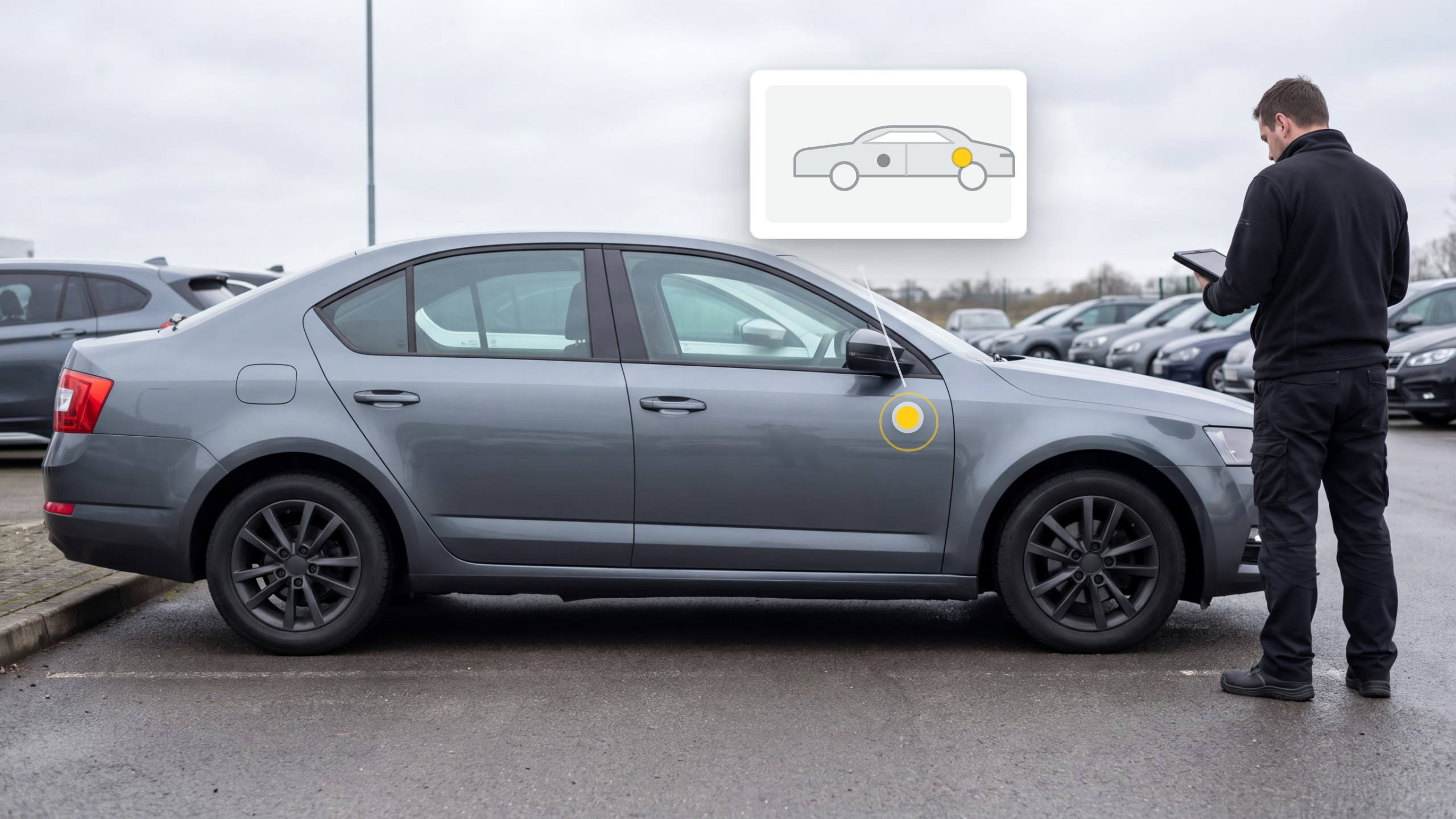
An inspector prepares the report on-site, takes standardized photos, and electronically checks the vehicle for battery condition, fault codes, and mileage. The COS Check displays OBD-2 readings and service history directly in the condition report, allowing buyers to base their bidding decisions on fault code, battery, and mileage data—not just on photos.
The key is the consistent format. Enrico Carenza, a Mercedes-Benz dealer at Trivellato S.p.A. in Vicenza, describes the benefit this way: “We know exactly what we’re buying even before we purchase it. Every vehicle comes with a detailed condition report, always in the same format, always containing the same information. This makes it easy to compare vehicles and gives us the confidence to buy even from a distance.” Comparability reduces the inspection time per vehicle and minimizes post-purchase complaints.
Guaranteed price as a basis for reliable cost estimates
The COS Guaranteed Price is a binding minimum retail price based on actual transactions on Basis , which is factored into the calculation before the order is accepted. You can count on a fixed lower limit rather than an estimate, and you won't sell below value.
This is particularly relevant for battery-electric vehicles. In March 2025, three-year-old used electric cars were worth, on average, only 51.5 percent of their original new-car price, whereas three-year-old Petrol were worth 64.0 percent (Deutsche Automobil Treuhand, DAT). Given this depreciation trend, a guaranteed lower limit represents the difference between the calculated return and the open margin. The tips on margin calculation in the automotive trade illustrate how this affects the overall bottom line.
How Digital Channels Reach the Right Buyers Faster
Mileage alone doesn't sell a car. What matters is showing the car to the buyer who is looking for exactly this model, this mileage, and these features. Digital channels achieve this through filters, curated showrooms, and notifications—rather than by chance or through a phone list.
It is a proven fact that the search process begins online: According to Deutsche Automobil Treuhand, 84 percent of all used-car buyers research vehicles on online sales platforms; among those under 30, the figure is 93 percent (Deutsche Automobil Treuhand, DAT). The same behavior applies to commercial purchasing, though under greater time pressure.
A Europe-wide customer base instead of a local network
A vehicle that is difficult to sell in Germany may be in demand in Poland, Romania, or Italy. Through platforms like CarOnSale, sellers can reach commercial buyers in multiple markets without the need for an in-person appointment. This addresses a structural problem in the industry, as the fragmented procurement landscape in Europe continues to separate supply and demand along national borders.
Trust is built through key metrics. Each listing displays the seller’s performance metrics, such as vehicles sold, renegotiation times, and document delivery times; sellers with strong metrics are awarded a “Top Partner” badge. Reliability is evident even before the first bid is placed.
Live Auctions vs. Buy It Now
Two formats, two purposes. The B2B online auction fosters price competition and is suitable for vehicles with broad demand. The “Buy Now” option at a fixed price speeds up the process and is suitable when the time the vehicle spends on the lot poses a greater risk than the final selling price.
The two can be combined: If you set a “Buy It Now” price when listing the vehicle, it can be sold at that fixed price before the auction ends. A market-based minimum price also increases the listing’s visibility. Cox Automotive shows that digital tools drive satisfaction: 84 percent of primarily digital vehicle buyers who used AI assistants were very satisfied with the entire purchasing process (Cox Automotive).
What steps are involved in the post-award process?
The sale doesn't end with the bid. Transportation, paperwork, and payment determine whether the time the vehicle spends in stock actually decreases or is merely shifted. A vehicle that has been sold but is waiting four weeks for the transporter continues to tie up capital.
Transport, Documentation, and Payment—All from a Single Source
Europe-wide transportation from pickup to delivery, automated shipping orders for documents, and a streamlined payment process take the coordination burden off your team. Invoices are issued in the buyer’s language and compiled into a single overview. Shipping orders for documents are automatically monitored and re-initiated if errors occur. The overview of common errors in B2B auto sales highlights the typical pitfalls that cause delays.
The importance of this aspect is often underestimated. According to the Descartes Systems Group, 81 percent of the shippers and logistics service providers surveyed view transportation management as a competitive differentiator or competitive advantage (Descartes Systems Group). And 41 percent of companies are already using generative AI in transportation management for data entry (Descartes Systems Group).
Complaint Management as a Factor in Building Trust
Clear rules after the purchase reduce the risk for both parties. If a defect arises, there needs to be a defined process, a deadline, and an authority to make the decision. Dealers who know that complaints are handled in an orderly manner will bid on the next vehicle as well.
The same applies to bids that fall just short of the minimum price. If an auction leads to a structured renegotiation rather than ending without a result, the vehicle remains in the process. During the final two minutes, the highest bidder can see, via a progress bar, how far they are from the renegotiation range.
Digital Channels and Traditional Auctions: What Affects Sales Time
The time it takes to make a sale depends on four key factors: data quality, number of buyers, pricing, and the level of transaction processing. A channel is only as fast as its weakest link. A large buyer base is of little use if the condition report does not allow for remote decision-making.
A Comparison of Speed, Cost, and Range
Traditional on-site auctions are scheduled on specific dates, require transportation costs to be paid in advance, and attract buyers who travel to the location. Digital channels launch the sale as soon as the file is complete and reach buyers regardless of their location. The cost model is also shifting: If there are no base or listing fees and you only pay upon a successful sale, this changes the cost calculation per vehicle and the risk involved in testing a new channel. The classification of vehicle auctions for dealers provides an overview of the different types of providers.
Pressure remains high on both sides of the market: In 2025, 44 percent of those planning to buy a used car cited high upcoming repair costs and the lack of cost-effectiveness of their current vehicle as the main reasons for their planned purchase (Deutsche Automobil Treuhand, DAT). Whoever can deliver when the need is urgent will win the sale.
What to Consider When Choosing a Marketing Channel
Data quality: Is it verified electronically, or is the report based on visual inspection and photos?
Buyer base: How many commercial bidders are active, and which markets do they come from?
Level of service: Does the channel handle transportation, documentation, payment, and claims, or does it only act as an intermediary?
Integration: Can your existing system be integrated so that vehicles can be listed for sale without duplicate entries?
Pricing Model: Do you pay on an ongoing basis or only if the project is successful?
It’s also worth taking a look at the options available to you when selling used vehicles and which channel is best suited to which vehicle segment.
Key Points at a Glance
Measure lead time from the date of receipt to the date of payment, not to the date of award, and manage purchasing based on this figure.
Enter vehicle data automatically once and forward it, instead of retyping it into three different systems.
Never sell a vehicle without a standardized condition report that includes an electronic inspection if the buyer will not be able to see the vehicle.
For vehicles with volatile values—especially battery-electric vehicles—set a mandatory minimum price before accepting them.
Count the number of manual steps in your process between the bid and payment, and transfer them to a system like CarOnSale, which handles transportation, documentation, and payment.
Frequently Asked Questions About Digital Remarketing in the B2B Automotive Industry
What is the difference between digital remarketing and traditional retargeting?
In the automotive industry, digital remarketing refers to the resale of physical used cars via digital platforms, including appraisal, condition reports, auctions, and transaction processing. Retargeting in online marketing, on the other hand, refers to advertisements that re-engage previous website visitors. The only thing the two have in common is the word; the process itself is different.
What types of vehicles are suitable for digital B2B remarketing?
Leased return vehicles, trade-ins, fleet vehicles, and battery-electric vehicles are particularly suitable. What they have in common is that their arrival can be planned, they can be documented, and they rarely fit in the dealership’s showroom. Especially with electric vehicles, electronically inspecting the battery and the error log pays off because it reduces price uncertainty.
How quickly can a vehicle be sold through a digital platform?
The time it takes to sell a vehicle depends on four factors: the completeness of the vehicle data, the quality of the condition report, pricing in line with market conditions, and the size of the buyer base. A vehicle with a complete file, a standardized report, and a realistic minimum price will attract a bidder much faster in a live auction format than a listing with gaps in the information.
Are there any costs involved if a vehicle isn't sold?
Not with performance-based models. There are no listing or advertising fees; the fee is only charged upon a successful sale, and the vehicle appraisal—including the listing—is free of charge with no minimum quantity required. When comparing platforms, check to see if there are any hidden fees, such as storage fees, pre-transport costs, or minimum volume requirements.
Conclusion
Digital remarketing isn’t just another sales channel; it’s a process chain: data, condition, buyer, and transaction processing. Those who digitize all four links reduce the amount of capital tied up per vehicle and make profits more predictable. Those who digitize only one of them simply shift the bottleneck. Start where you’re still typing, making phone calls, and following up today.


